
Story Mindset
Thinking in Stories: How the Story Mindset Offers a New Perspective on Life


To harness the power of stories in our lives, we need to do more than just change the stories we tell ourselves. We need to develop what I call a "story mindset". My discovery of this mindset has been gradual and I don't think I've reached the final definition yet. However, what I have already discovered has served me well and I am delighted to share it with you. Please join me on this journey of discovery as I explain how I developed this mindset and how it has benefited me ever since.
My Journey Toward the Story Mindset
My Journey started with thinking about what makes a hero a hero. I needed to answer this question in order to move forward with my science fiction book. As you might guess It is not a question that can be answered on the spot, and I spent several weeks thinking about it before reaching the first insight of any worth. I felt like Alice in Wonderland. Every time I thought I had the answer, I realized that the rabbit had gone further down the hole and I had to follow it. I researched, I asked my friends, and I drew mind maps. But the answer always seemed to elude me. With time I managed to identify some characteristics of a hero. They were pretty similar to what you get when you google the subject, but my intuition kept telling me that these characteristics were just the tip of the iceberg and that there was something more fundamental to the makeup of a hero than the superficial characteristics that people immediately identify.
My first breakthrough was when I arrived with this insight:
"If you can't succeed, at least tell a good story."
Maybe you are asking what this has to do with defining hero makeup, but please bear with me, I will explain. I realized that a hero does not become a hero once he has achieved what he set out to achieve. In other words, when the story is successfully completed. That is what usually comes to our minds when we are asked about the characteristics of a hero. We identify the characteristics of the hero once he has become successful, but obviously, the hero didn't have these characteristics from the beginning. There were also likely several times when he faced setbacks and when he failed to uphold his values on his journey.
This was the reason why I didn't feel satisfied when I had the list of characteristics and attitudes of a hero. This list was an attempt to draw a line in the sand. It was an attempt to say: Up to that point he was an ordinary man, and only after he acquired all these admirable qualities did he become a hero.
Nowadays, many of us grow up in a framework that celebrates the end result but not the journey. Perhaps it is because only people who achieve certain tangible results are celebrated as successful. Or perhaps we have learned to base our worth on how much we achieve. As a result, we are drawn into endless efforts to control outcomes in order to promote our desired image of a successful good person. Unfortunately, this approach has many disadvantages. Focusing on the outcome forces us to make sacrifices that allow us to achieve that outcome in the desired time and in the desired way, and the cost of such sacrifices is unfortunately ignorance of our own values. In other words, we don't care whether we tell a good story, we care whether we achieve our end goal. While this may not necessarily lead us to use obviously questionable means, we may still neglect things that are important to us. Be it family, health, or something else.
A story Mindset is a completely different approach. The story Mindset doesn't focus on the end result, it focuses on making the story as good as possible. While the first insight I had - "If you can't succeed, at least tell a good story" - pointed me in the right direction towards this mindset, I later understood that this insight needed some refinement. The problem with this insight was that the 'good story' was devalued to a second-best goal to be pursued when success was not possible. But to really benefit from the Story Mindset, a good story must become the most important goal in your life. So I reformulated my insight in this way.
"A successful story is not about success, it is about telling a good story".
Now I was satisfied. This insight solved several unhealthy approaches at once. Instead of focusing on the end result at any cost, this approach focuses on taking actions that are aligned with one's values in the present moment. It also abandons the desire to control the outcome, stops denying reality, and adopts a healthier approach to achieving goals. Happiness becomes attainable in the present moment as one realizes that happiness is not a result of achievement but of living in harmony with one's values. It also solves the question I had about what makes a hero a hero. I think the following poem I wrote sums it up well.
"It is the first step in the right direction,
It is the humility to acknowledge that you have to grow beyond your current characteristics selection,
it is the acknowledgment that you have a lot to learn and change,
It is to surrender to the fact that success you can't arrange,
It is the humility to acknowledge that this journey will take time, and mistakes will be made,
and even with your best efforts and intentions setbacks will be faced."
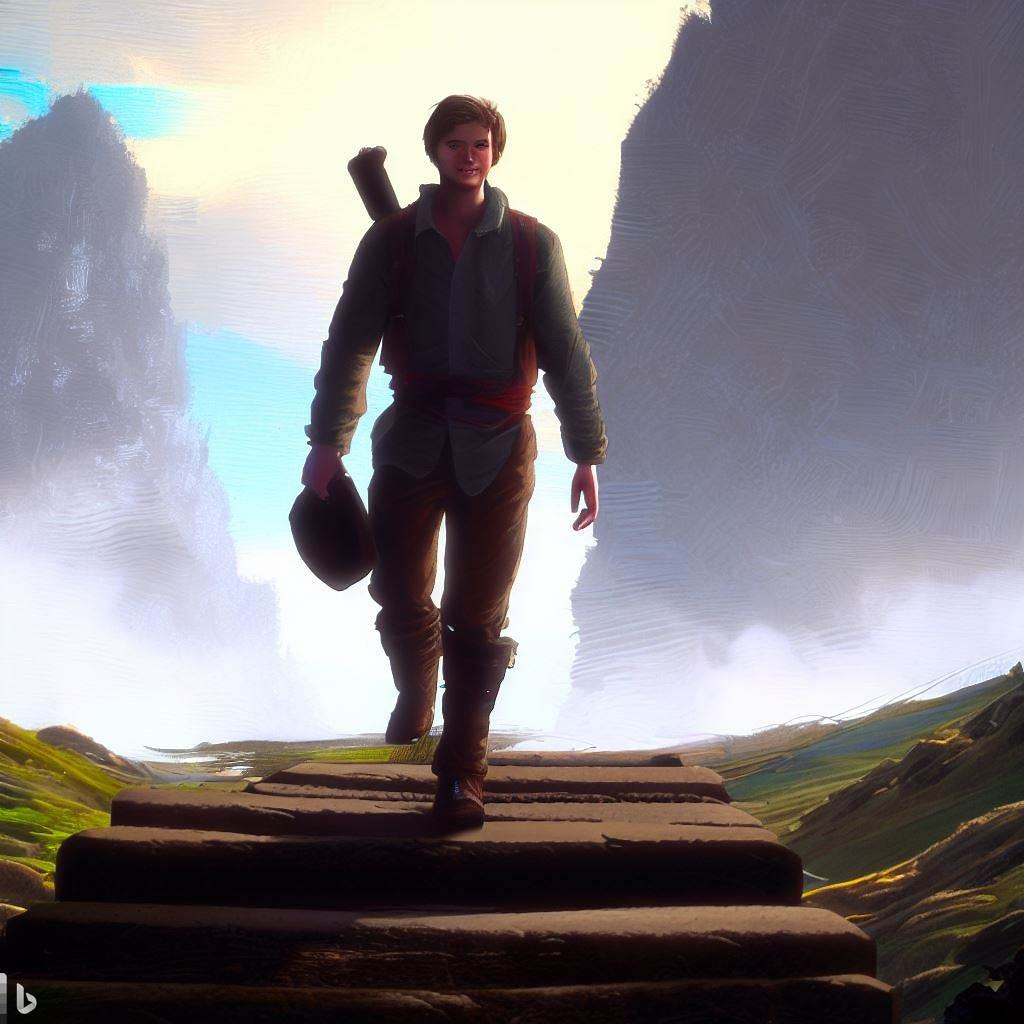
There is no such thing as how things should be.
When we adopt a story mindset, our perception changes. We realize that there is no such thing as "how things should be". The end result (or success) mindset taught us the opposite. We have always had an ideal idea of what the ideal future should look like. Since life happens to everyone and we can't predict the future, there will always be something between us and our ideal vision of our future, and we will have to course correct and accept reality. With a story mindset, we are better equipped to deal with these unexpected events. We realize that our idealization of how things should be is not realistic because it doesn't take into account the fact that life is unpredictable and that achieving our ideal would only be possible if we could predict and control the future.
To illustrate this point, consider this example. You are working on a project. You want to finish it within a week. But unexpected complications extend the project. The end-result-oriented mindset makes you feel anxious, or at least stressed. In an attempt to control the outcome, you allocate more time to the project, taking it away from other projects. However, the complications turn out to be more serious and you finish the project two weeks late. While the Story Oriented Mindset will not help you finish the project sooner, it will help you accept reality and likely reduce your stress level. Instead of trying to control the outcome, you evaluate the impact of the complications and calculate a new project schedule. You realize that the project "shouldn't be finished in a week" because reality has revealed that there is more work to be done. With Story Mindset, you focus on the process. You assess the importance of this project in the context of your other projects and give it the right priority that aligns with your or your organization’s values.
Dealing with failure
A story Mindset will also equip you better to deal with failure. With Story Mindset, failure is not the end. Failure is when the story gets interesting. It is the best opportunity to make your story good. The film industry proves this. Just think of how many films have this structure where a main hero pursues a certain goal, but then something happens and the hero faces failure or setback. Isn't this part of the film what fascinates us? We watch closely as the hero overcomes his failure by correcting his course and applying his problem-solving skills. And even if the story doesn't have a happy ending, don't we feel inspired when we see how the hero deals with the failure and shows the strength of character?
Story Mindset has taught me a simple technique that I use whenever I face a failure or setback. I acknowledge what happened out loud and then I add what my next action will be.
"This and that happened... but then James did..."
In other words, I think about what would make my handling of failure as inspiring as the handling of failure by the main characters in successful films. Realistically the majority of the time there is no one external who can observe us and feel inspired. But you will feel a surge of motivation as you are proud of how you handled the setback.
Setting up priorities
A story Mindset also helps us to understand that each of us creates a story about our own reality. In other words, although the ultimate facts and truths exist, we rarely communicate them. Rather, we tell our story about these facts. Understanding this has large-scale implications.
One of the implications is that "you will always be a villain in someone's story". No matter how hard you try to make a good decision in the context of your existence, there will always be someone who does not like your decision. This person may label your decision as selfish, not well thought out, ignorant, and so on... The reason for this is that we create stories about every person who plays a role in our lives. If their behavior doesn't match the character we have assigned to them in our story, we tend to label them. The same happens in reverse. If we don't play the role others have assigned to us in their stories, we may be labeled a villain, depending on how far we stray.
Understanding this will help us to realize that people-pleasing makes no sense. There are only as many people you can care enough about to make effort to play the character role they assigned to you. In my opinion, this privilege should be reserved only for our own family and closest friends. And even within this small circle, we have to prioritize and decide what script we want to stick to and where we have to stray.
Of course, this is not to say that we should behave like robots and always do exactly what our family and friends expect us to do. We have our own values and our own stories, and we are obliged to play our self-assigned character roles. But understanding that each of us has a desire that people in our social circle behave according to the character role we have assigned to them will help us understand what we need to do to make others happy. Put simply:
"Making others happy is not about how much you do for them, it is about how much you stick to the script they have assigned to your character."
Dealing with conflicts
Story Mindset can also help us deal with conflict in our relationships. Because it is not always possible or desirable to stick to the script at all times, we are going to have conflicts. If we understand that many of our conflicts exist because of the differences in our narratives, we are in a much better position to deal with them. For example, if we are called names or given ugly labels in the heat of an argument, we are less likely to take it personally. We realize that we are not really what we have been called. There is just a mismatch between the narratives. We can acknowledge the other side's position, realizing that in their story, we have indeed played a selfish person, while avoiding internalizing that label as we consider our story as well. We understand that we need to listen and update the script of the role that is expected of us while keeping in mind that we are not bad people because we know that according to our story, we made the best choices with the observations available to us.
Also, understanding that conflicts are about different narratives will help us to communicate our position better. Instead of trying to impose our narrative on the other person, we will listen and try to understand their narrative first. Only then can we begin to communicate our position. If we want our position to be accepted, it is crucial that we communicate in a way that is compatible with the other side's story. Conflicting narratives are immediately blocked. Our aim should be to enrich the other narrative, not to contradict it.
I hope that from these few examples, you can see how powerful Story Mindset is. In the next article, I will share with you one of the tools I have developed to effectively deal with the negative narratives that pop up in our heads from time to time. As I mentioned in the previous article, this tool was inspired by the Twitter community/context notes. Stay tuned.
James